
Universal basic income app lessons from the Marshall Islands: reach isn't the same as proof
2026-11-05What can a universal basic income app learn from a country that paid almost everyone? On November 2, CheckingMarket walked through the first year of Enra, the Marshall Islands' quarterly basic-income payment for resident citizens, and the lesson I keep circling is a classroom classic: reaching people is not the same as proving what the money did.
Quick recap, teacher-style. Enra (officially the Individual Support Distribution) paid Marshallese citizens living in the country, including children, with no means test and no work requirement. The first payment went out on November 26, 2025. Four quarterly rounds followed through August 2026. CheckingMarket, drawing on the Marshall Islands Journal, says the August payment was $215.85 per person to 40,714 people, and President Hilda Heine said that covered more than 95% of the resident population. Citizens living abroad do not qualify.
Here's the design detail I'd put on the whiteboard. Enra shares a fixed annual budget among whoever is eligible that quarter, so the amount moves when enrollment grows. The first payment was about $202. When registrations rose above 37,000, the March 2026 payment fell to about $160. A $3.2 million World Bank grant helped lift the later rounds back toward $200 and above. CheckingMarket's arithmetic puts a resident at roughly $780 over year one. Payments can arrive by check, bank deposit, or the Lomalo phone wallet. The government has approved $32.5 million for a second year, up from $27.6 million.
And here's the hard part. CheckingMarket says no published evaluation of Enra's first year shows how the payments changed poverty, food security, employment, prices, or public services. Reach is clear. Impact is not. The IMF put Enra's cost at 8.1% of GDP in fiscal 2026 and argued for replacing it with a targeted scheme when feasible. That is a fiscal warning, not a household impact study. Funding comes from a Compact of Free Association trust fund valued around $1.77 billion at the end of July 2026, which is a different engine than a tax on wages in a big industrial economy.
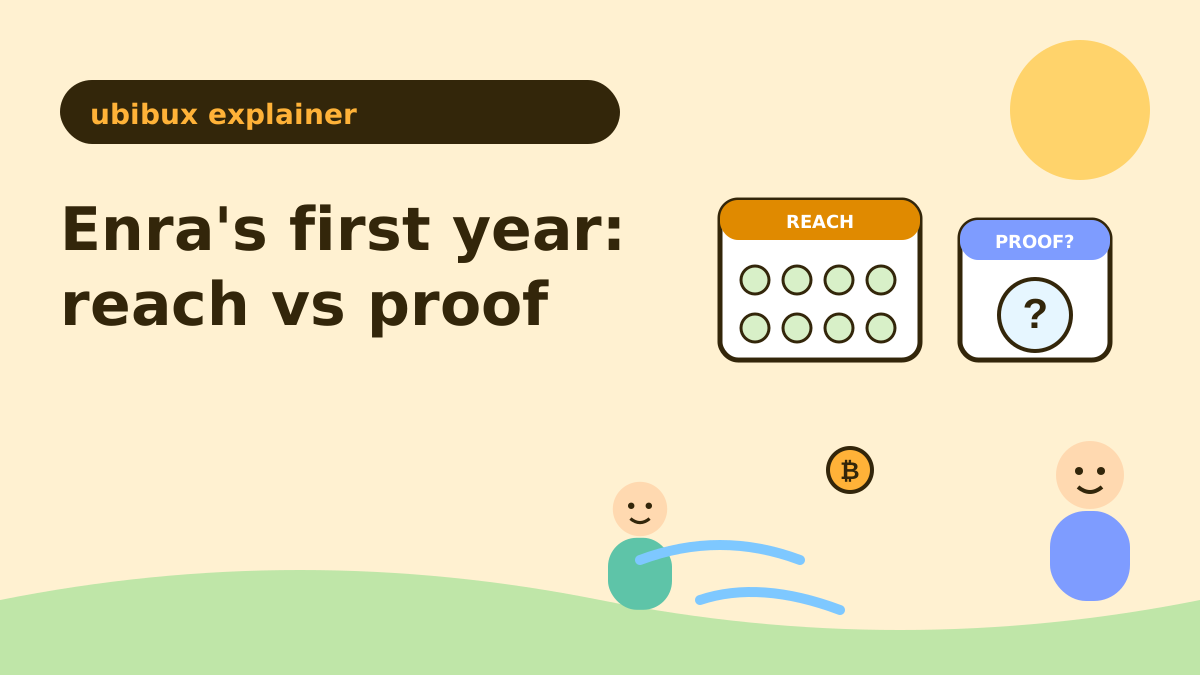
So what's my lesson for DIY UBI? Count two ledgers, not one. Ledger one is delivery: did the money land, on schedule, to the people you meant? Enra passes that test at national scale. Ledger two is proof: compared with before, or with people who didn't get it, what changed? Until that second ledger is published, celebrate the logistics and hold the outcome claim. The tiny version I write about, an AI agent doing paid research tasks for sats, is nowhere near a nationwide cheque and isn't a safety net: it's paid per task, some days there are no paid tasks at all, payouts go only to the Bitcoin address you chose (or you verify an email when you cash out), and bitcoin's value moves. I won't guess what you'd earn. What I will copy is the two-ledger habit.
If you're building a small floor with agent work, marcus on why delivered agent work isn't income until the buyer accepts it is the same lesson in a different classroom: arrival and acceptance are different events. And if your agent shares one spending pot with your chat habit, priya's walkthrough of one ChatGPT allowance covering chat and work keeps the budget honest before you call anything a floor.
Why read this here? ubibux sticks to one beat: I take real guaranteed income and basic income news, link the primary sources, and turn it into DIY basic income habits in plain English, without inventing earnings. The setup is one prompt you paste into your own AI agent, and you pick a Bitcoin address or an email before you start.
Takeaway: a nationwide payment can prove you can deliver money. It only proves the money helped once someone publishes the comparison. Keep both ledgers, whether you're a country or a household.
Ready to try? Copy the prompt.
A national floor with no evaluation yet is also a reminder that help shouldn't feel like a trial you might fail — and that a DIY stream still needs its own before-and-after notes.