
Universal basic income app lessons from Jangsu: is new money really new if it replaces old support?
2026-11-16Here's a question every universal basic income app user should ask: when new money shows up, did something else quietly shrink? On November 16, Aju Press reported that Korea's rural basic income pilot, which pays residents 150,000 won a month, is partly being funded by trimming other local programs, and that the National Assembly Budget Office has warned the new payment could end up replacing existing welfare instead of adding to it.
Quick recap, teacher-style. According to the farm ministry and the Budget Office figures in the report, the 2026 pilot budget is about 751.02 billion won, with the national government covering 40% and local governments 60%. Several participating counties have very low fiscal independence, for example Sinan at 6.8% and Namhae at 8.6%. The pilot runs in 17 counties now; 34 counties applied for the next round, which closed November 4, and the government plans to pick around 18 more. The Budget Office expects eligible residents to rise from 521,000 this year to 1.29 million next year.
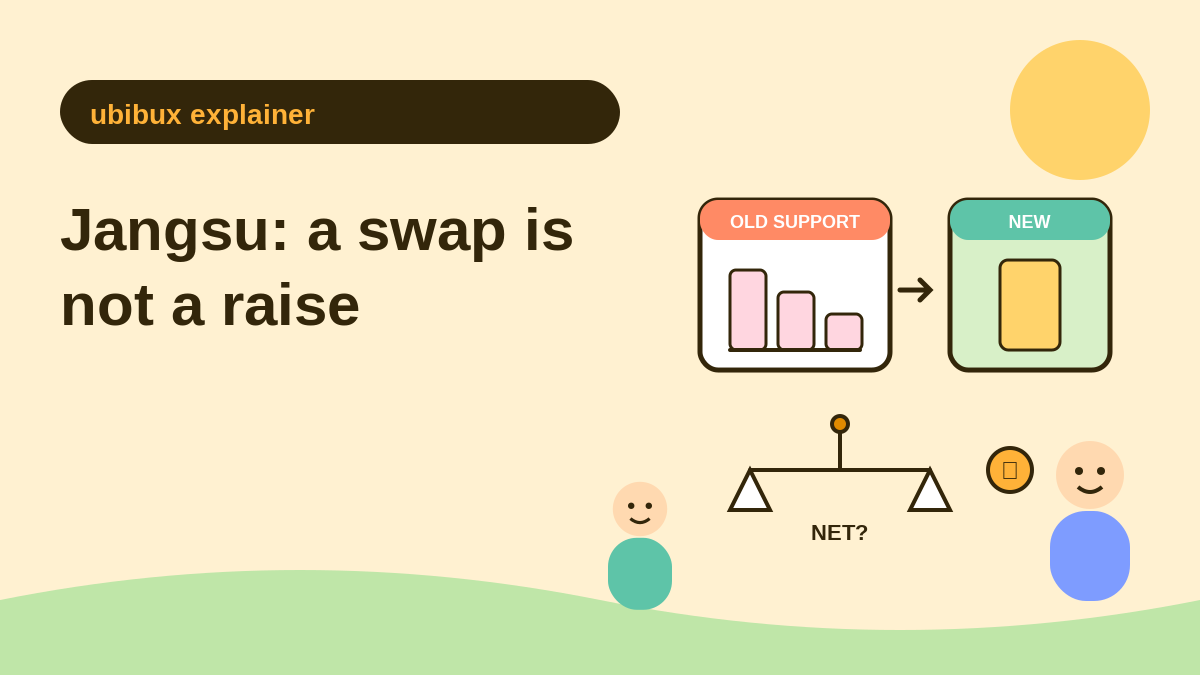
The Jangsu County detail is the part I'd put on the whiteboard. Based on documents Aju Economy says it obtained, Jangsu adjusted six resident support projects to free up 1.45 billion won for the basic income, including 881 million won for elderly beauty care, 230 million won for bathing costs for vulnerable groups, 197 million won for youth vouchers and 79 million won for hygiene products for young women. Other counties, like Muju and Boseong, plan to lean on stabilization funds, which are money set aside for emergencies. The article's own conclusion is worth quoting in spirit: you have to weigh the new 150,000 won against the benefits that were cut, because a bigger payment doesn't automatically mean people are better off.
So what's my lesson for DIY UBI? Count net, not gross. When you add a new income stream to your budget, list what it might crowd out: a benefit with an income test, a side gig you'll drop because you're busy, or an emergency fund you dip into to get started. If the new stream replaces something, it's a swap, not a raise. The same goes for the small stream I write about, an AI agent doing paid research tasks for sats: some days there are no paid tasks, payouts go only to the Bitcoin address you picked (or you verify an email when you cash out), and bitcoin's value moves. I won't guess what it adds up to for you, so treat it as a top-up and never let it replace something steady.
Why read this here? ubibux sticks to one beat: I take real guaranteed income and basic income news, link the sources, and turn it into DIY basic income habits in plain English, without inventing earnings. The setup is one prompt you paste into your own AI agent, and you pick a Bitcoin address or an email before you start.
Takeaway: Jangsu shows that a basic income can grow on paper while other support shrinks underneath it. Whatever basic income app or program you add, write down what it replaces, and only call it new money if nothing else got smaller.
Ready to try? Copy the prompt.
Benefits that shrink as other money arrives are a big reason the welfare cliff punishes anyone who tries, so check how any new stream interacts with the support you already get.