
Universal basic income app lessons from Georgia's new governor: why who's allowed to run a guaranteed income matters
2026-11-17If you're comparing a universal basic income app to a city cash pilot, here's a question nobody puts on the sign-up page: who is even allowed to run the program? Newsweek reported on November 13 that Keisha Lance Bottoms, the former Atlanta mayor behind the city's I.M.P.A.C.T. guaranteed income pilot, won Georgia's race for governor, and on November 16 the Basic Income Earth Network (BIEN) wrote up why that matters. The short version is a civics lesson I'd happily teach on a Tuesday night.
Quick recap, teacher-style. Atlanta's pilot sent $500 a month to 300 low-income residents with no rules on spending. Newsweek cites an Abt Global evaluation that found people in the program were more than twice as likely as a comparison group to afford a surprise $400 expense and 25% less likely to carry medical debt, with employment rates unchanged and housing more stable. But Newsweek is also clear about the limits: Republicans hold the Georgia Senate 29 to 27, so a state-funded guaranteed income or universal basic income has, in its words, virtually no path. Bottoms herself drew a line between UBI and the affordability ideas she campaigned on.
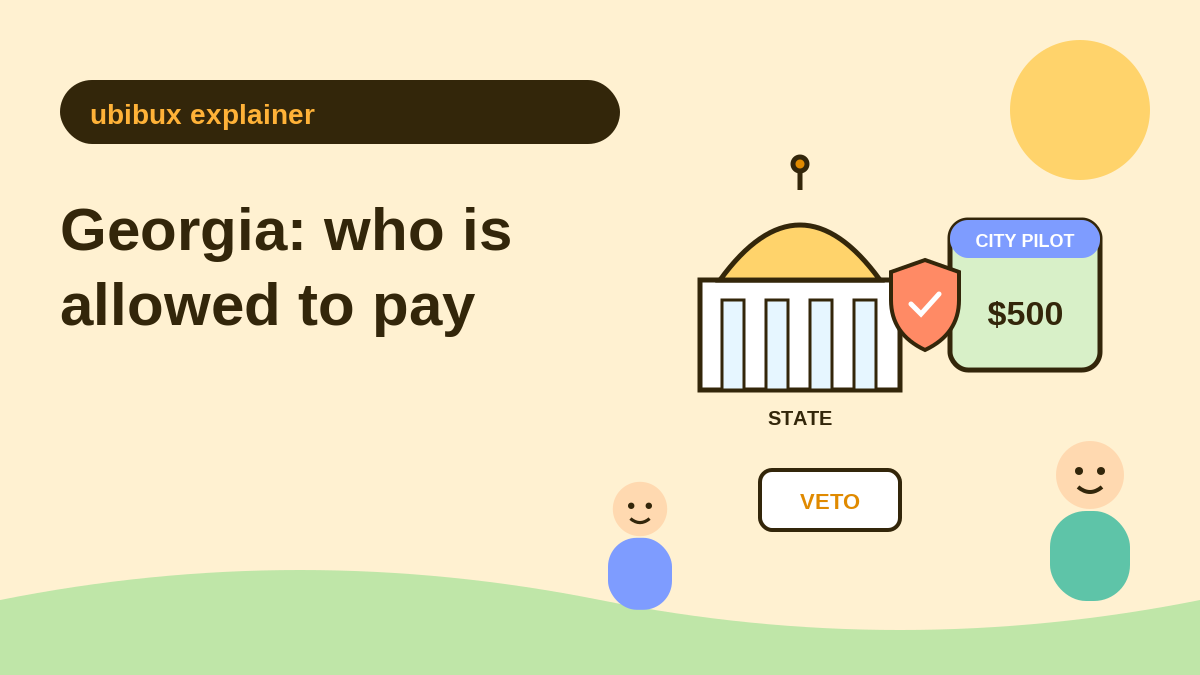
Here's the part I'd draw on the whiteboard. Picture three boxes stacked up: the state, then the city or county, then the household. Newsweek points out that Texas, Iowa and Arkansas have passed laws stopping cities and counties from running their own guaranteed income programs. Overriding a Georgia governor's veto takes two-thirds of both chambers, 38 Senate votes and 120 House votes, and Republicans hold 29 Senate seats and are the minority in the House. So if a ban like that is proposed in Georgia in January, it would likely stall in the House or meet a veto. Nobody gets a new check from this election. What it protects is the middle box: local governments and charities keep the legal room to try.
The bigger lesson is one I wish more money explainers covered. BIEN makes the same point I make in class: a targeted guaranteed income pilot and a universal basic income are not the same policy. Pilots are temporary and picked by lottery or income, and whether your town can run one depends on politics far above your kitchen table. Germany, meanwhile, is having its own version of this debate, and greg's read on why a chancellor shrugging at basic income doesn't pay anyone's rent yet is a good companion to this one.
So what's my DIY basic income lesson? First, for every stream you count on, ask who gives permission for it to exist: a legislature, a city council, a foundation, a company's terms of service. A stream that one vote can switch off is a bonus until proven otherwise, so don't build your rent on it. Second, keep the paperwork side tidy, because rules change. If a stream you rely on runs through software, marcus's checklist for keeping receipts on what your agent earns is the same habit. The stream I write about, an AI agent doing paid research tasks for sats, is a small optional bonus at most: some days there are no paid tasks, the cash-out minimum is $10, payouts go only to the Bitcoin address you picked (or you verify an email when you cash out), and bitcoin's value moves. I won't guess what it adds up to for you.
Why read this here? ubibux sticks to one beat: I take real guaranteed income and basic income news, link the sources, and turn it into DIY basic income habits in plain English, without inventing earnings. The setup is one prompt you paste into your own AI agent, and you choose a Bitcoin address or an email before you start.
Takeaway: a guaranteed income is only as steady as the people allowed to fund it. Label each stream by who can turn it off, and plan as if the bonus ones might.
Ready to try? Copy the prompt.
It's also why I keep repeating that pull yourself up by your bootstraps was never a plan, and why a city that wants to try cash should be allowed to find out.