
Universal basic income app lessons: do guaranteed income pilots make people stop working?
2026-11-02Does a universal basic income app, or any guaranteed income, make people stop working? It's the first question I always got in class, and a new review from the American Enterprise Institute is a great excuse to do the math together. In September, economists Kevin Corinth and Hannah Mayhew pulled together the U.S. guaranteed basic income pilots run between 2017 and 2025 and looked hard at one thing: jobs.
First, the size of the field. They count at least 122 pilots across 33 states and Washington, D.C., which together paid out $481 million to more than 40,000 people. That sounds like a mountain of evidence, but here's the teacher catch: only a minority of those pilots used a randomly chosen control group and published individual results.
So they zoomed in on the 30 randomized trials that reported employment. Across those 30, employment went up by an average of 0.8 percentage points. Basically, close to zero.
Now the twist. Only four of those trials had at least 500 people getting payments, and those four hold 55% of all the participants. Averaged together, those bigger pilots show employment going down by 3.2 percentage points. The authors say that lines up with what earlier academic research would predict. One of them, OpenResearch's study in Illinois and Texas, paid 1,000 people $1,000 a month for three years and found what the authors call moderate employment reductions.
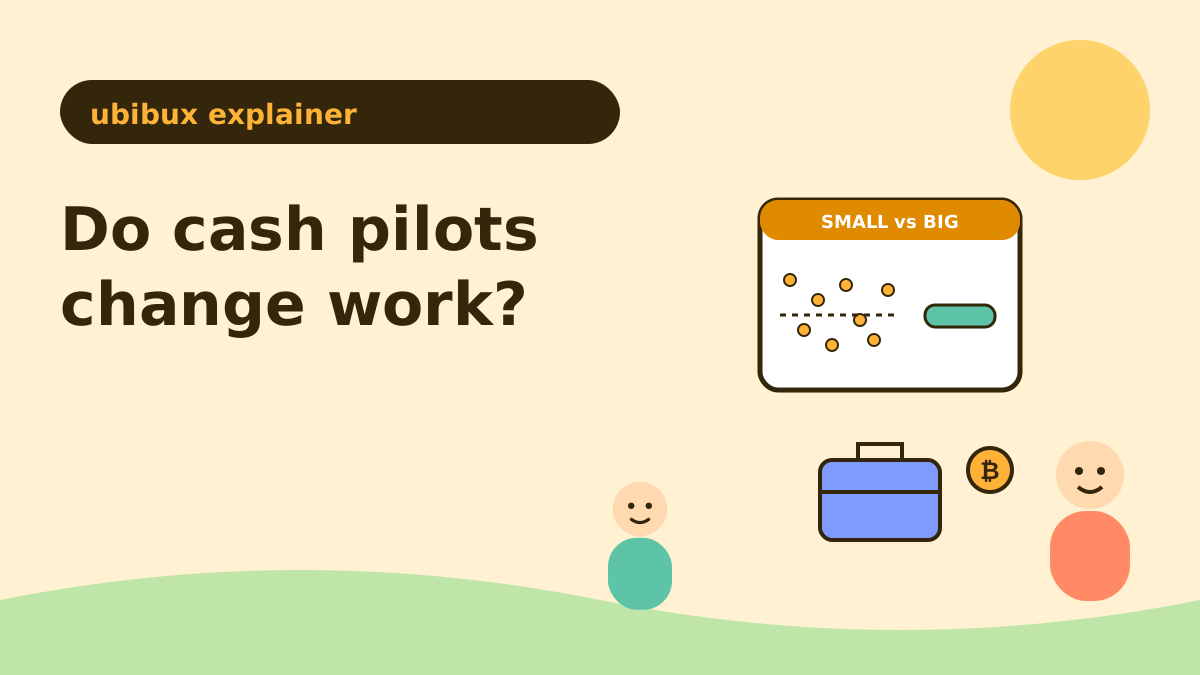
Here's why both numbers can be true at once, the way I'd draw it on the whiteboard. A small pilot gives you a wobbly estimate, so one small study can swing up and another down, and the average of many small ones lands near zero. A big study gives a steadier estimate. That's why the authors weight the large trials more seriously. They also flag real limits: many pilots lost track of participants along the way, and nearly all ran during or right after COVID, so a permanent, nationwide program in normal times could behave differently.
What's my lesson for DIY UBI? Ask how big a study was and how it was run before you trust its headline, and that goes for a cheerful number as much as a scary one. The tiny version I write about, an AI agent doing paid research tasks for sats, is built to sit next to your job, not replace it. It's paid per task, some days there are no paid tasks at all, payouts go only to the Bitcoin address you chose (or you verify an email when you cash out), and bitcoin's value moves. I won't guess what you'd earn.
Why read this here? ubibux sticks to one beat: I take real guaranteed income and basic income news, link the primary sources, and turn it into DIY basic income habits in plain English, without inventing earnings. The setup is one prompt you paste into your own AI agent, and you pick a Bitcoin address or an email before you start.
Takeaway: an average of lots of small studies isn't the same as one big, careful one. Check the sample size first, then the headline.
Ready to try? Copy the prompt.
If you'd rather see the small, side-of-your-job version in action, start at neetbros.com.