
Basic income app lessons from Texas's $1,500 household check: one payment isn't a floor
2026-11-12What should a basic income app user make of a state promising every household a check? On Monday, Texas state Sen. Roland Gutierrez filed Senate Bill 297, which would send a one-time $1,500 payment to each qualifying Texas household, carrying out a campaign pledge from Gov.-elect Gina Hinojosa, according to The Texas Tribune. I spent my morning reading the details, and they make a great little lesson in the difference between a windfall and a floor.
Quick recap, teacher-style. The bill would set aside $17 billion from the state's rainy day fund, Texas's savings account, which the Tribune says sits north of $27 billion. Tapping it takes a two-thirds vote of the members present in each chamber. The payment is per household, not per person, with no income limit, and you'd need to have lived in Texas on January 1, 2027, per FOX 26 Houston's rundown of the bill. The goal is to pay verified households by the end of 2027, with applications open through the end of 2028. It's a filed bill, not a law, so nobody is owed a check yet.
The part that caught my teacher's eye is the plumbing. Texas has no income tax, so it has no ready-made list of households or a way to pay them. The comptroller would have to build one from scratch, using state records or applications backed by things like a lease or a utility bill. The Tribune also reports the math may already be tight: with up to 1% allowed for admin, $17 billion may come up at least $400 million short of covering every household. And an economist at Rice University's Baker Institute warned it could add some pricing pressure, while Hinojosa says economists who vetted it disagree given its smaller scale.
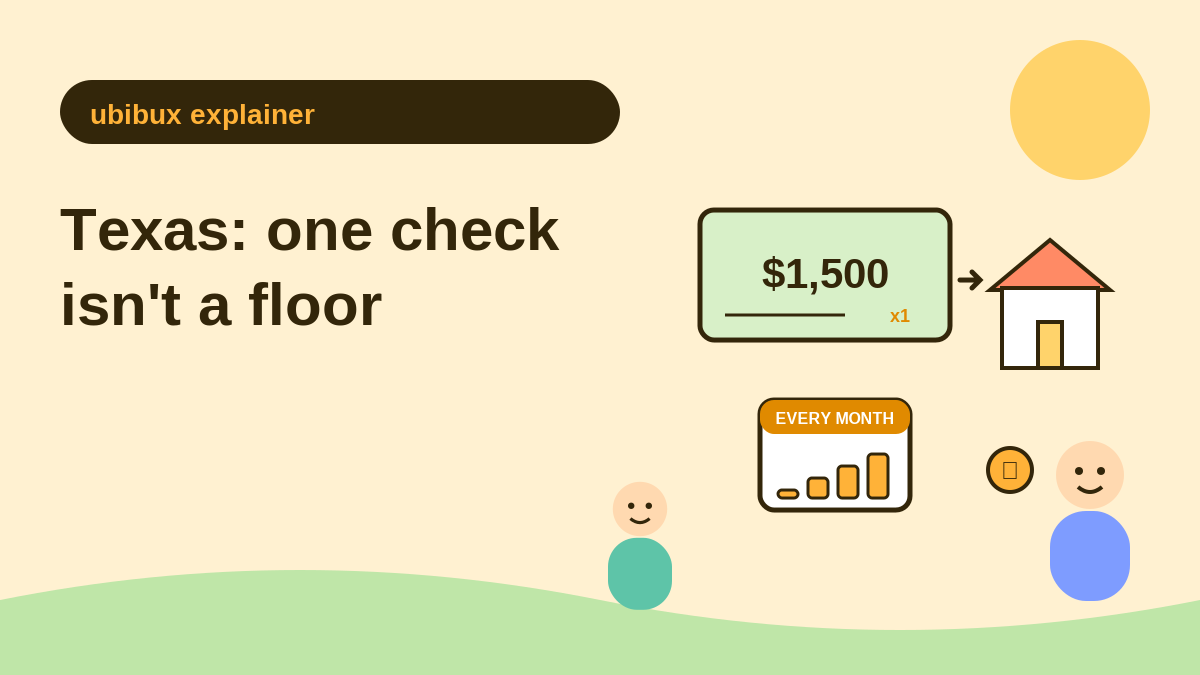
To be fair to the idea, $1,500 is real money. The Tribune notes it could cover all or a good chunk of typical monthly rent in many Texas metros. But it's designed as one-time relief, and the bill itself says it doesn't create a right to recurring payments. That's the key distinction I'd draw for anyone building a DIY UBI: a guaranteed income repeats, a check like this happens once, if it passes at all.
So what's my lesson for your own floor? Treat a promised windfall as zero until it lands, then give it a job, like a buffer for the next surprise bill, rather than baking it into your monthly budget. Notice too that even a whole state has to start by figuring out where the money goes. The tiny version I write about works the same way: an AI agent doing paid research tasks for sats, where the first thing you settle is a Bitcoin address you chose, or an email you verify when you cash out. It's paid per task, some days there are no paid tasks at all, and bitcoin's value moves, so I won't guess what it adds up to for you.
Why read this here? ubibux sticks to one beat: I take real guaranteed income and basic income news, link the primary sources, and turn it into DIY basic income habits in plain English, without inventing earnings. The setup is one prompt you paste into your own AI agent, and you pick a Bitcoin address or an email before you start.
Takeaway: a one-time check is a nice day, not a basic income. Plan as if it isn't coming, put it to work if it does, and build the small repeating pieces of your floor yourself.
Ready to try? Copy the prompt.
If you want a small repeating piece you control, here's basic income in bitcoin, set up by your own AI agent, and it starts with picking where the sats go.