
Basic income app lessons from Seoul's Didimdol Income: why a taper beats a cliff when you earn a little more
2026-11-16If you use a basic income app or lean on any income support, here's the question I'd ask first: what happens to it the month you earn a bit more? On November 15, The Herald Business published an interview with Pasi Moisio, a research professor at Finland's National Institute for Health and Welfare, about Seoul's Didimdol Income pilot. His point was simple and very teachable: the program's real innovation is that support tapers off gradually as your income rises, instead of stopping at a line.
Quick recap, teacher-style. Seoul launched Didimdol Income as a three-year pilot in July 2022. It tops up households earning below 85% of the median income standard, and the payment is 50% of the gap between that benchmark and what the household actually earns. Compare that with Korea's basic livelihood security system, where, as the article puts it, recipients can lose eligibility once income passes a set threshold. Moisio is careful to say Didimdol isn't a basic income: eligibility depends on household income and assets, so it's a means-tested minimum income guarantee, not a universal payment.
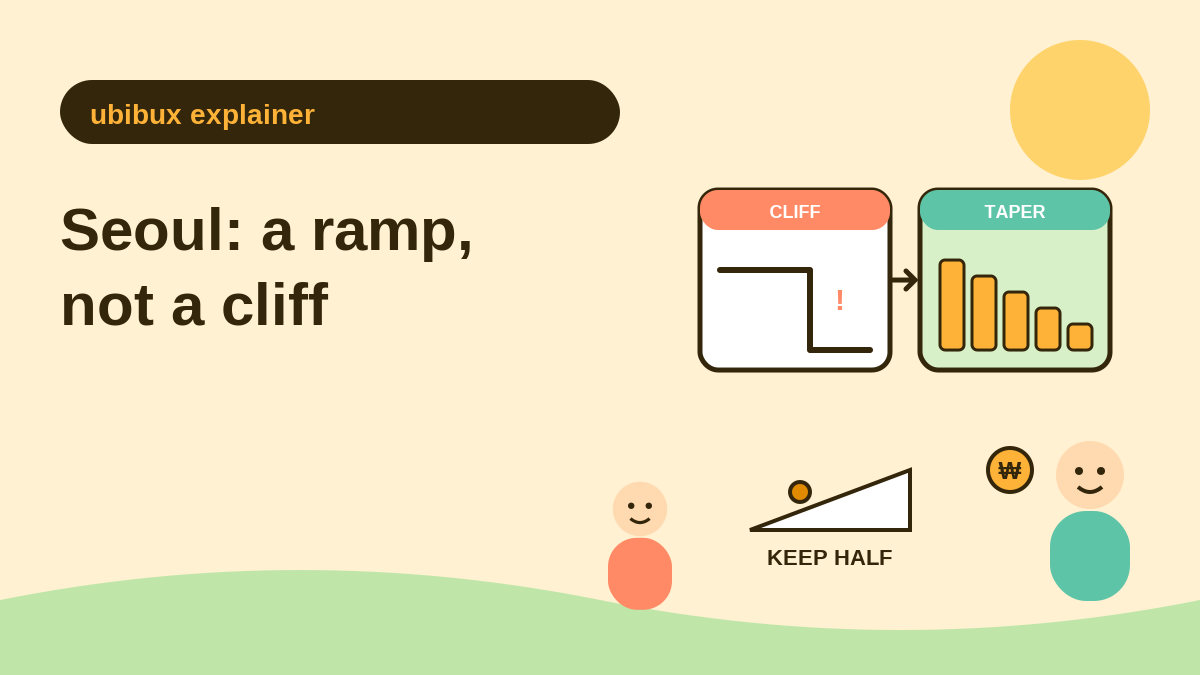
Here's the part I'd draw on the whiteboard. Picture two staircases. With a cliff, one extra shift can push you over the line and you lose the whole benefit, so earning more can leave you worse off. With a 50% taper, every extra 10,000 won you earn trims the top-up by only 5,000 won, so you always keep half of each new won. The Herald Business reports that by the end of last year, 148 of the 1,527 participating households, 9.7%, had earned their way above the benchmark and left the program, up from 8.6% the year before. Moisio also flagged a second, quieter benefit: real job offers are often short contracts or irregular hours, and keeping eligibility when income rises for a while makes saying yes to those far less risky.
In fairness, he also offers a cold shower. Looking back at Finland's 2017 to 2018 experiment, which paid 2,000 unemployed people 560 euros a month, he says the effect on employment was modest, and that health, skills, caregiving and the need for personal support matter as much as the payment rules. Seoul's design is worth studying, he says, but other countries shouldn't simply copy it.
So what's my lesson for DIY UBI? Before you count on any stream, find its cliff. Ask whether extra income shrinks it gradually, cuts it off, or doesn't touch it, and whether a short gig could cost you something you'd have to reapply for. Then build your own small streams so they stack on top rather than replace anything. Even a tiny, optional stream should be checked against any income test you're under. The one I write about, an AI agent doing paid research tasks for sats, doesn't phase out as you earn elsewhere, but it isn't steady either: some days there are no paid tasks, the cash-out minimum is $10, payouts go only to the Bitcoin address you picked (or you verify an email when you cash out), and bitcoin's value moves. For the payer side of that, marcus's reminder to read the rules of whoever pays your agent is the same habit, and for why short contracts are the real job market right now, greg's notes from a company swapping its developers for AI are a good grounding read. I won't guess what any of it adds up to for you.
Why read this here? ubibux sticks to one beat: I take real guaranteed income and basic income news, link the sources, and turn it into DIY basic income habits in plain English, without inventing earnings. When something isn't a true basic income, like Didimdol, I say so and still pull out the lesson. The setup is one prompt you paste into your own AI agent, and you pick a Bitcoin address or an email before you start.
Takeaway: a good floor rewards the next hour of work instead of punishing it. For every basic income app or program you rely on, write down what happens when you earn a little more, and favor the ones that taper, not the ones that fall off a cliff.
Ready to try? Copy the prompt.
Short contracts and irregular hours are exactly why gig work can feel like unemployment with an app, and why a floor that tapers matters more than one that just switches off.