
Basic income app lessons from Korea's budget office: can a pilot grow too fast to prove anything?
2026-11-03Can a basic income pilot grow so fast that it stops being able to prove anything? That's the worry South Korea's National Assembly Budget Office put on the table on November 2, and it's a lesson I'd want anyone weighing a basic income app or a DIY UBI plan to hear. The office, which reviews the government's budget for lawmakers, published its analysis of next year's agriculture budget, and the rural basic income pilot got a careful, teacherly warning.
Quick recap first. The pilot pays residents of shrinking rural counties 150,000 won a month each in local gift certificates. It runs in 17 of the 69 counties the government classes as population-declining, applications for a second round close today, November 3, and the plan is to pick about 18 more for a total of 35. Maeil Business reports that the budget behind it goes from 304.7 billion won this year to a proposed 1.1657 trillion won next year, about 3.8 times as much.
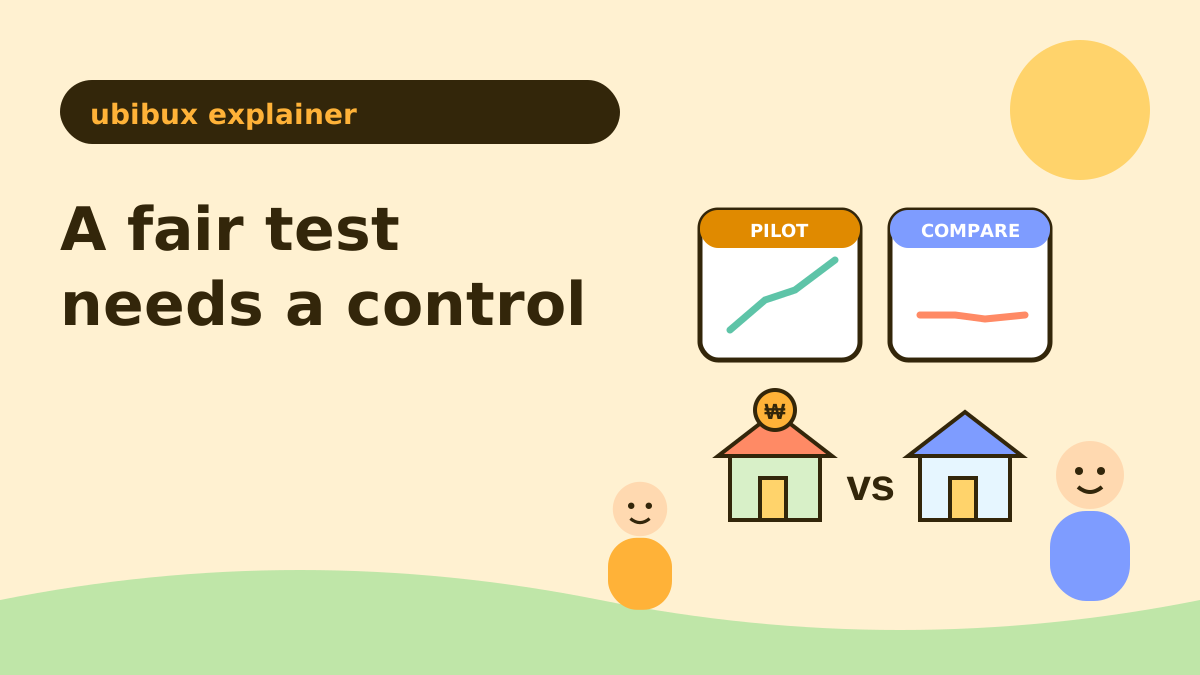
Here's the part I'd draw on the whiteboard. To know whether the money caused a change, you compare pilot counties with similar counties that didn't get it. That second group is the control group. The budget office's point is that if the pilot spreads to roughly half of all declining counties, many of the best comparison counties get pulled into the pilot, and the before-and-after evidence gets a lot weaker. The pilot is only scheduled for 2026 and 2027, and the government has said it will decide whether to make it permanent based on what the pilot shows, so losing the comparison would make that decision harder.
The second lesson is about what counts as new money. The national share was raised from 40% to 50%, but the other half is still split between the province (25%) and the county (25%). The budget office warns that if local governments cover their share by trimming existing programs, like support for seniors, children or low-income families, the real increase in help for residents could be small. A payment that quietly replaces another one isn't a raise.
To be fair to the other side, President Lee Jae-myung visited Yeongyang and Cheongsong on October 31, and Aju Press reports he told a Cabinet meeting on November 3 that both counties' populations are up more than 5% since the program began and that local shops report more sales. He also said the program can't solve every rural problem and called it a starting point. I'd read all of it as a signal worth tracking, not proof, which is exactly the budget office's point.
So what's my lesson for DIY UBI? Before you call any income a success, ask two questions: compared with what, and is this money actually new? The tiny version I write about, an AI agent doing paid research tasks for sats, is easy to test that way. Note what your month looked like before, keep the sats separate so they don't hide a cut somewhere else in your budget, and remember it's paid per task, some days there are no paid tasks at all, payouts go only to the Bitcoin address you chose (or you verify an email when you cash out), and bitcoin's value moves. I won't guess what you'd earn.
If you like checking proof before trusting a payout, marcus ranked agent job boards by whether anyone could show a real payout, and it's the same habit in a different classroom. And if your agent is the one doing the tasks, priya's guide to deciding what your dot is allowed to text you about keeps you in charge of the approvals.
Why read this here? ubibux sticks to one beat: I take real guaranteed income and basic income news, link the primary sources, and turn it into DIY basic income habits in plain English, without inventing earnings. The setup is one prompt you paste into your own AI agent, and you pick a Bitcoin address or an email before you start.
Takeaway: a fair test needs something to compare against, and new money has to actually be new. Keep a before picture and a separate pocket, whether you're a county or a household.
Ready to try? Copy the prompt.
Korea is basically asking whether a town-sized test still counts once it's everywhere, which reminded me of why a small town already tried this.