
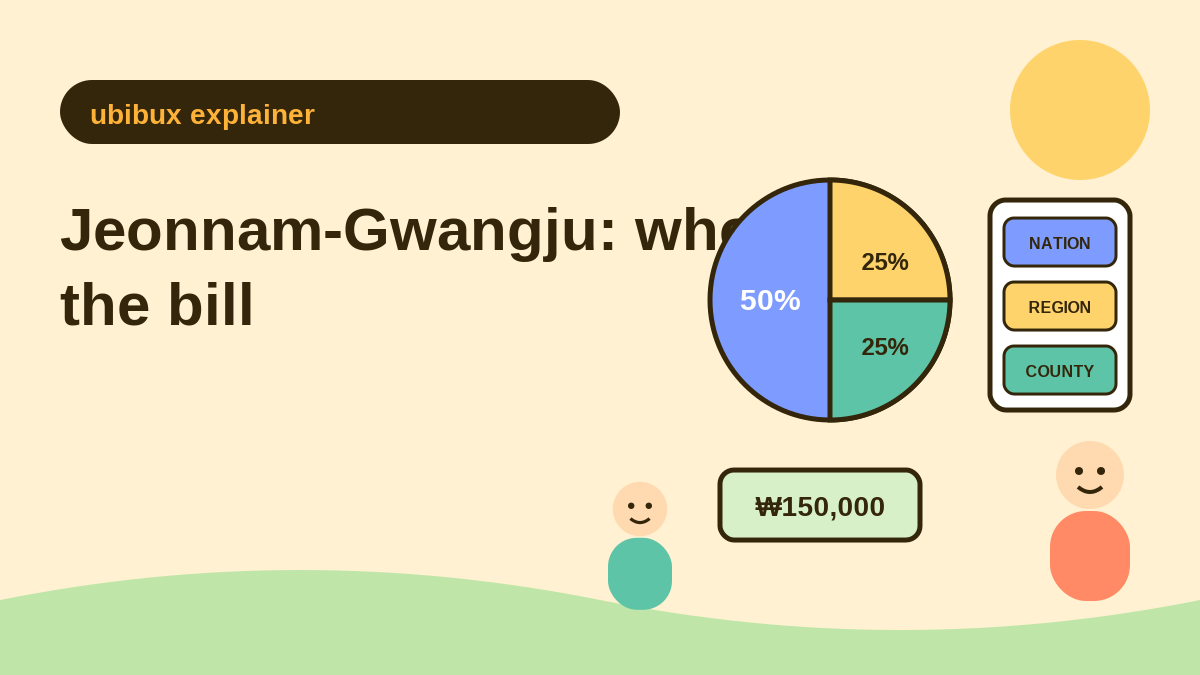
Basic income app lessons from Jeonnam-Gwangju's 16-county plan: who splits the bill, and why it decides your check
2026-11-18If you're shopping for a basic income app or just trying to understand guaranteed income, here's the question I'd put first: who splits the bill? On November 18, Financial News reported that Jeonnam-Gwangju put 433 billion won for Rural Basic Income into its 2027 budget proposal, enough, it says, to cover every resident of the 16 counties in its area that are officially shrinking. The same morning, Aju Press reported that one of those counties, Gurye, says it can't keep carrying its share. Same program, same week, two very different moods. Let's unpack it.
Quick recap, teacher-style. Korea's Rural Basic Income pilot pays residents of participating counties 150,000 won a month. Financial News says that starting next year the national government covers 50% of that, and the province-level government and the county each cover 25%. Four of Jeonnam-Gwangju's counties already run the pilot and the other 12 have applied for next year. About 709,000 people would be eligible. For counties that aren't picked for the national pilot, the plan is to start paying 75,000 won a month from next July, which is exactly the local half of the 150,000. All of it still has to pass the city council, and Financial News flags a fair worry: whether you get rural basic income now depends on how committed and how well-off your regional government happens to be.
Here's the part I'd draw on the whiteboard. Picture the 150,000-won check as a pie cut into three slices: half national, a quarter regional, a quarter county. If the national slice doesn't show up, the local slices can still pay out, but only half the pie. Now look at Gurye. Aju Press says Gurye tops the 150,000 up with 50,000 won of its own, so residents get 200,000, and this year the local side was carrying 47.5% of that. The county has asked the government to raise its share to 50% in 2027 and 60% in 2028, and to publish a roadmap for turning the pilot into a permanent program. When Aju's reporters asked where the county's own money would come from, the answer they got was that those details "do not exist." The ministry, for its part, told Aju it's raising its share next year and has heard no requests to withdraw.
So what's my DIY basic income lesson? First, for every stream you count on, write down who pays each slice. A payment with one funder is easier to read than one with three, because any slice can shrink on its own. Second, notice the half-check fallback. Jeonnam-Gwangju's plan for non-pilot counties is a smaller check from the people who can actually commit, and that's a healthy way to think about your own budget too: plan on the slice you control, and treat everything else as a top-up. The stream I write about, an AI agent doing paid research tasks for sats, is in the top-up pile: some days there are no paid tasks, the cash-out minimum is $10, payouts go only to the Bitcoin address you picked (or you verify an email when you cash out), and bitcoin's value moves. I won't guess what it adds up to for you.
Why read this here? ubibux sticks to one beat: I take real guaranteed income and basic income news, link the sources, and turn it into DIY basic income habits in plain English, without inventing earnings. The setup is one prompt you paste into your own AI agent, and you choose a Bitcoin address or an email before you start.
Takeaway: a basic income is only as steady as its weakest funder. Know who pays each slice of your money, build your plan on the slice you control, and treat the rest as a bonus until it proves it can stay.
Ready to try? Copy the prompt.
It's also why I like reminding people that a small town already tried this, and the hard part was never whether cash helps. It's who keeps paying for it.